
A route to revenue
At Klein Aub the ore was mined, crushed and deposited decades ago. Reprocessing surface tailings and slimes avoids building a new mine first, which is typically the slowest and most capital-hungry step.
Three projects across two of the world's most productive base metal districts. A near-term route to revenue in Namibia, and discovery upside along Ireland's Rathdowney Trend.
Klein Aub, Kilmallock and Lisheen, across copper, zinc, lead and silver
Historic tailings already at surface at Klein Aub (in-house estimate)
Of prospecting licences on the Rathdowney Trend, Ireland
Most explorers offer either production potential or discovery potential. We offer both. Klein Aub gives us a brownfield copper and silver project where the material has already been mined and sits on surface. Our Irish licences give us exposure to new discoveries in a district that has already produced world-class zinc mines.
At Klein Aub the ore was mined, crushed and deposited decades ago. Reprocessing surface tailings and slimes avoids building a new mine first, which is typically the slowest and most capital-hungry step.
Lisheen and Kilmallock sit on the Rathdowney Trend, next to the Lisheen and Galmoy deposits and along strike from Group Eleven's Ballywire discovery. We hold untested gravity targets in the same host rock.
Copper sits at the centre of electrification and grid investment. As a small company, a single drilling success or a move towards production would be significant relative to our size.
These are our goals, not guarantees. We will report progress on each through RNS and on this hub.
Namibia · Near term
Close our 75% interest in QGC Namibia and establish our operating presence on site.
Read the announcementNamibia · Ongoing
Continue glycine leach test work with Draslovka on copper, and begin testing silver extraction.
Read the announcementNamibia · Next 12 months (our aim)
Define the economics of reprocessing and advance the project towards production.
Read the announcementIreland · Next step
Complete the 340-station survey to sharpen the five untested anomalies before any decision to drill.
Read the announcementThree contiguous licences covering 136.76 km² in County Limerick, on the southwestern extension of the Rathdowney Trend. We sit about 20km south of Pallas Green, the largest undeveloped zinc deposit in Ireland, and 8km along strike from Group Eleven's Ballywire discovery, which shares our geology and structural setting.
Hole 3249-24 includes 3.40m at 20.62% Zn and 3.43% Pb. Six of the seven intercepts also carry between 23.55 and 133.79 g/t silver.
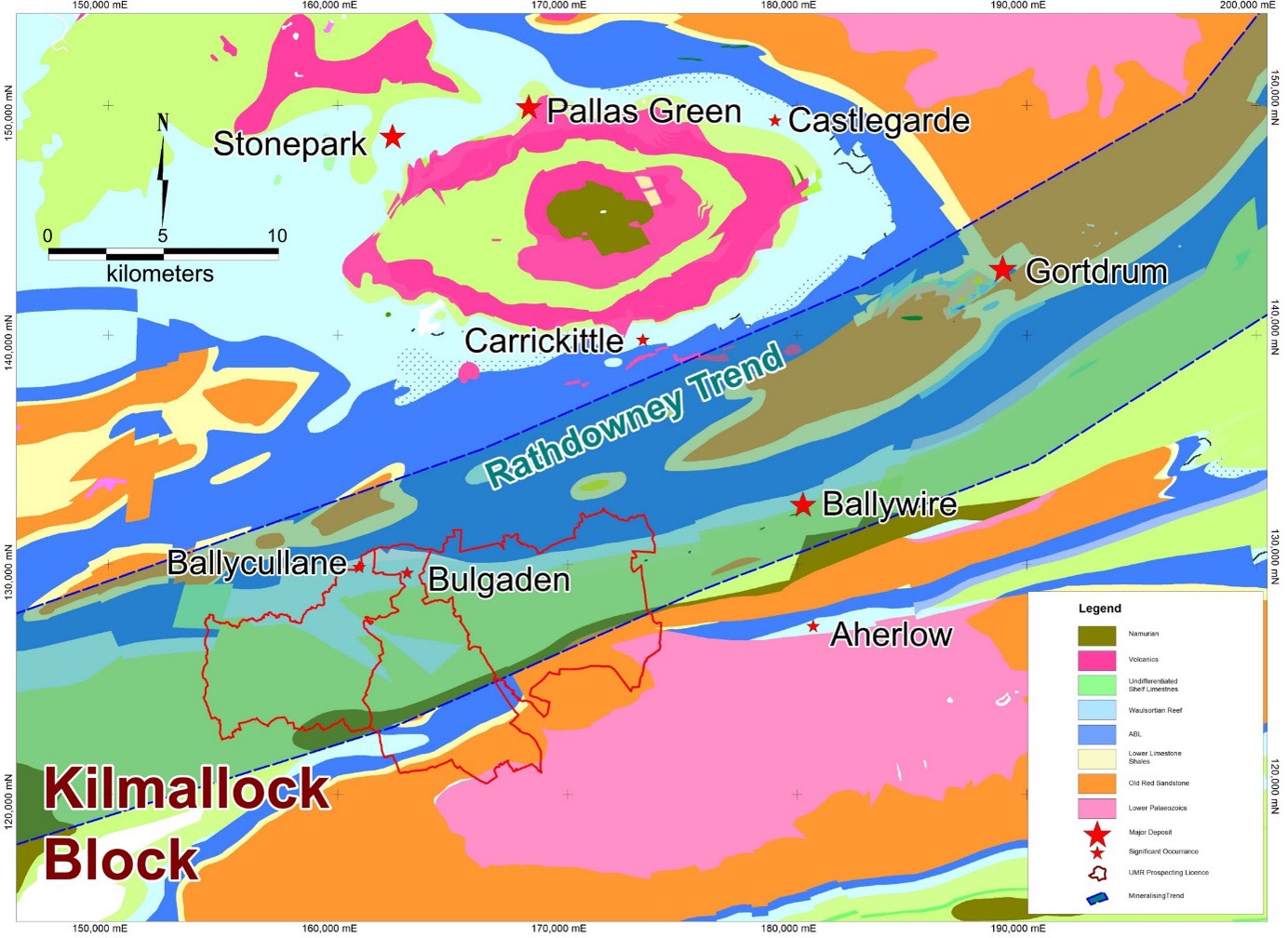
Boliden's drilling has already confirmed base-of-reef massive sulphide mineralisation on our ground. Next door, Ballywire is being drilled with multiple rigs and remains open. Same geology, same structural setting, a short distance along strike.
In July 2024 we surveyed 174 new gravity stations to a nominal 250m by 250m grid. Modelling identified five discrete, strongly anomalous zones over prospective stratigraphy and structure. Our gravity response compares closely with the survey Group Eleven has used to target its drilling at Ballywire.
Pastureland served by the M7, M8, N20 and N24, with the Dublin to Cork railway running through the block.
On 15 September 2026 we signed a share purchase agreement to acquire 75% of Q Global Copper Namibia, which holds the historic Klein Aub mine and two exclusive prospecting licences covering 6,536 hectares. The mine operated from 1966 to 1986 and left a large tailings dam and a smaller, higher-grade slimes dam on surface.
Tailings and slimes figures are in-house estimates (silver 7.4 g/t and 33.55 g/t respectively), not a compliant Mineral Resource. Historic ore averaged 50 g/t silver.
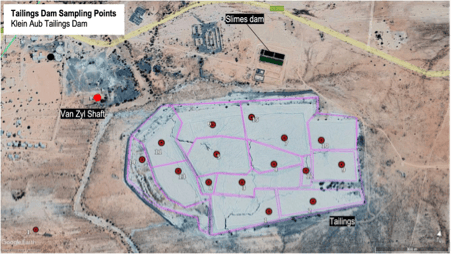
The surface material needs no mining to access. The site already has road access, a nearby electrical substation and water from the historic underground shafts. Beyond the dams, roughly 2Mt of ore is estimated to remain in the old workings, and outcropping copper mineralisation runs along strike.
The material is rich in carbonate, which makes acid leaching uneconomic. We are working with Draslovka on glycine leaching. Early tests returned copper recoveries of up to 70% from slimes and up to 45% from tailings, and later tests with oxidation and higher temperature improved on that. Silver recovery is still to be tested.
The acquisition and initial work programme are funded through a £1.25m unsecured loan facility. Our aim is to progress a bankable feasibility study and advance Klein Aub towards production over the next 12 months.
Two contiguous licences covering 70.69 km² across Counties Tipperary and Laois, immediately north of the former Lisheen mine and west of Galmoy. Extensions of the main controlling faults at both deposits can be traced onto our licences.
Neighbouring deposit figures are approximate historic totals. Our target range is an exploration objective, not a resource.
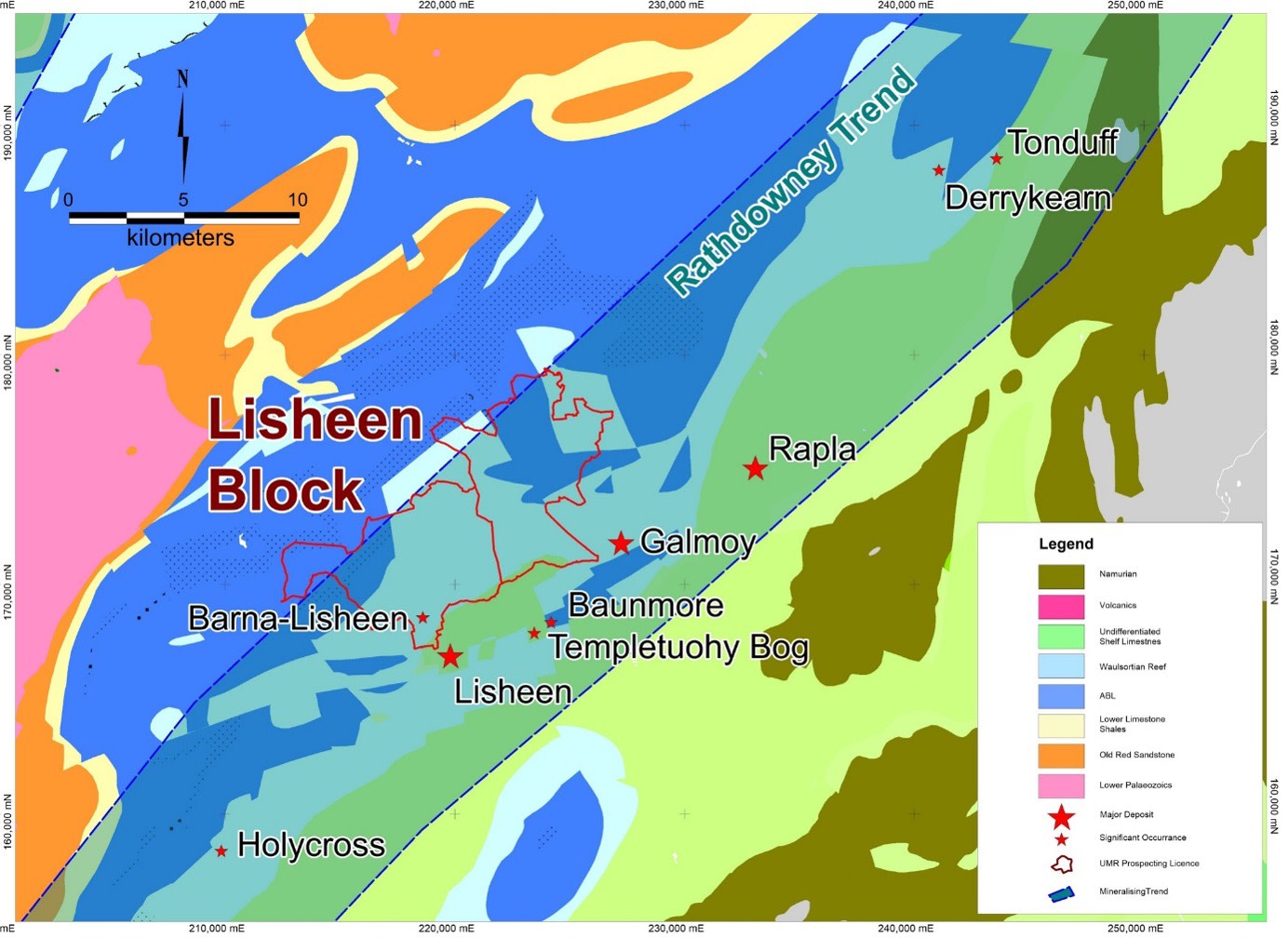
The planned reopening of the nearby Galmoy mine by Shanoon Resources, targeting around 300,000 tonnes of ore a year, opens the possibility of a mining centre fed by several smaller deposits. A 5 to 10Mt discovery on our ground could fit that model.
We are targeting relatively shallow massive sulphides, around 200 to 300m deep, at the base of the Waulsortian Reef. 3D gravity modelling shows density anomalies on a northwest trend parallel to Galmoy's K Zone, and four strongly anomalous zones at depth that historic drilling has not tested.
Served by the M8 and N62, with the Dublin to Cork railway through the centre of the licences.
Current price
Volume
Market Cap.
Year low - high
Market data chart (LSE:UMR)
Last price
Open price
Day low - high
Price change
Percentage change
Previous close
Volume (no. of shares)
Turnover
Market cap
Shares outstanding
VWAP
Bid / Ask
52 week high
52 week low
Price/earnings ratio
Earnings per share